Your next customer is asking AI Search, not typing ten blue links.
Google just made AI Mode a mainstream search surface: longer questions, multimodal inputs, follow-ups, agents, and background monitoring. This is the playbook for getting cited by ChatGPT, Perplexity, Google AI Search, Gemini, Claude, and Copilot — without hiring an agency.
Visitors who arrive via AI buy 4.4× more often than Google visitors.
Of all the pages ChatGPT reads, only ~15% get quoted. Structure decides who.
The average AI Mode search is roughly triple the length of a traditional Google query.
AI Mode has passed one billion monthly active users globally.
AI crawlers run zero JavaScript. If your site needs JS to show text, it's invisible.
What happens between a question and an AI answer
If you only read this panel, here's the whole thing. The rest of the page is the how.
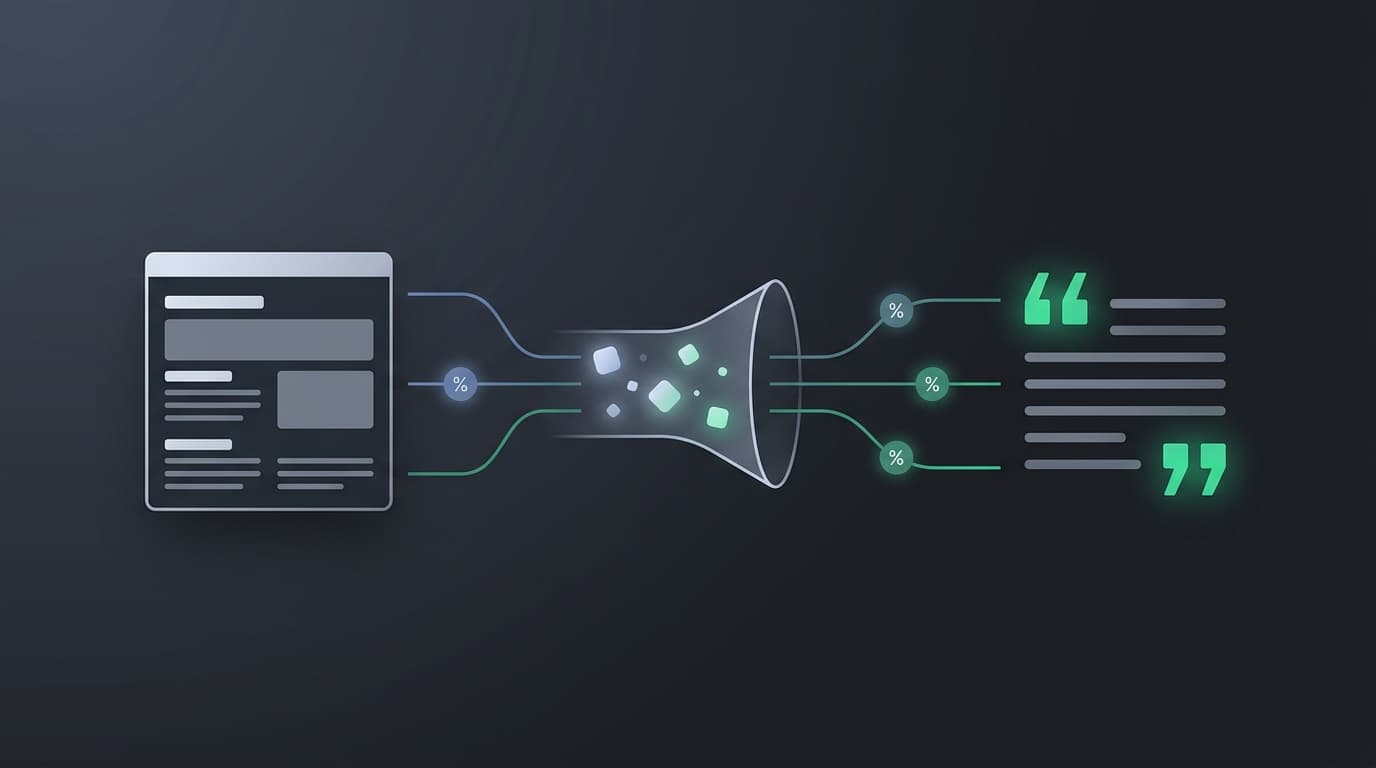

AI answers are becoming AI Search
ChatGPT, Google AI Mode and AI Overviews, Perplexity, Gemini, Claude, and Microsoft Copilot all pick sources differently. But Google’s May 2026 Search update changes the center of gravity: conversational, multimodal, agentic search is now a default behavior, not a side experiment.
Structure beats volume
Adding real numbers to your page raises your citation rate by 41%. Expert quotes add another 28%. FAQ sections triple your chances. The AI rewards pages written to be quoted — not just read.

Measure what AI sees
AI traffic is only about 1% of your visits today — but it converts 4.4× better. You can't improve what you can't see, so track how often you're cited, not just how often you rank.
Keep scrolling for the evidence, the tactics, and the 90-day plan.
A four-step pipeline — same for every engine
Every AI search engine follows roughly the same recipe. Google now documents the same pattern for AI Mode and AI Overviews: query fan-out across subtopics and data sources, followed by synthesis with supporting links.
The AI fans the query out
One long prompt becomes many related searches. Google calls this query fan-out; other engines do similar retrieval expansion. Your first job is to have crawlable, specific pages for the sub-questions the model will create.
It picks a shortlist
The AI scores results on eligibility, freshness, trust, structure, and information gain. For Google, pages must be indexed, snippet-eligible, and visible as text. Most pages get dropped here — only the useful handful move on.
It breaks pages into quotable chunks
The AI splits each winner into short passages, one topic per paragraph. Pages with clear headings and a summary at the top survive this step. Walls of text don't.
It writes, links, and may act
The AI assembles its reply from the best chunks, adds supporting links, keeps context for follow-ups, and may pass the user into a booking, shopping, or tracking flow. Only about 15% of pages that made the shortlist actually get quoted.
Google’s shift makes density matter more, not less.
Google still says classic SEO is the eligibility floor for AI Mode and AI Overviews. But longer, follow-up-heavy searches reward pages with unique proof, clean entities, product/offer data, and direct answers. Thin pSEO pages lose because there is nothing worth retrieving after fan-out.
The AI fans the query out. One long prompt becomes many related searches. Google calls this query fan-out; other engines do similar retrieval expansion. Your first job is to have crawlable, specific pages for the sub-questions the model will create. It picks a shortlist. The AI scores results on eligibility, freshness, trust, structure, and information gain. For Google, pages must be indexed, snippet-eligible, and visible as text. Most pages get dropped here — only the useful handful move on. It breaks pages into quotable chunks. The AI splits each winner into short passages, one topic per paragraph. Pages with clear headings and a summary at the top survive this step. Walls of text don't. It writes, links, and may act. The AI assembles its reply from the best chunks, adds supporting links, keeps context for follow-ups, and may pass the user into a booking, shopping, or tracking flow. Only about 15% of pages that made the shortlist actually get quoted.
Five content moves with measured impact
Princeton researchers tested specific tactics and measured how much each one raised citation rates. Industry follow-ups replicated the findings. These are the ones worth doing.
Link out to authoritative sources
+30 to +115%When you cite real sources in your content, AI treats your page as corroborated and quotes it more often. The effect is biggest for pages that don't already rank highly.
Use real numbers and statistics
+41%AI treats numbers as facts it can safely quote. A page with 'trusted by thousands' gets ignored; a page with '3,247 customers' gets cited.
Include expert quotes
+28%A direct quote from a credentialed person is the highest-confidence signal an AI can find. If you don't have experts on staff, interview customers or industry peers.
Show when the page was last updated
+18 to +22%AI strongly prefers fresh content. Add a 'Last updated' line at the top and the matching `dateModified` tag in the page code. Then actually update — not just the date.
Put the answer in the first paragraph
+18%Almost half of ChatGPT's citations come from the first 30% of a page. Lead with the direct answer in 40 to 60 words. Put your backstory below.
AI loves Q&A format — it matches how people ask questions. Add 3–5 real customer questions with direct answers at the bottom of each important page.
Let the AI robots in
Before any of this matters, the AI has to be able to read your site. Many sites block the AI robots by accident — often via a default setting from years ago. Fixing it takes five minutes.
Training robots
These visit your site to help train the next model version. Blocking them protects your content from being absorbed. Allowing them means you might be remembered by future models as a default answer.
GPTBotOpenAIClaudeBotAnthropicGoogle-ExtendedGoogleBytespiderByteDanceCCBotCommon CrawlLive-search robots
These visit your site the moment someone asks the AI about your topic. Block any of these and you disappear from that AI's answers — today. Always allow these.
OAI-SearchBotOpenAIChatGPT-UserOpenAIClaude-WebAnthropicClaude-SearchBotAnthropicPerplexityBotPerplexityPerplexity-UserPerplexityApplebot-ExtendedAppleMeta-ExternalAgentMeta# Allow all retrieval crawlers — blocking these makes you invisible
# in ChatGPT Search / Claude / Perplexity / Apple Intelligence / Meta AI
User-agent: OAI-SearchBot
Allow: /
User-agent: ChatGPT-User
Allow: /
User-agent: Claude-Web
Allow: /
User-agent: Claude-SearchBot
Allow: /
User-agent: PerplexityBot
Allow: /
User-agent: Perplexity-User
Allow: /
User-agent: Applebot-Extended
Allow: /
User-agent: Meta-ExternalAgent
Allow: /
# Training crawlers — decide per-brand (distribution vs. IP protection)
User-agent: GPTBot
Allow: /
User-agent: ClaudeBot
Allow: /
User-agent: Google-Extended
Allow: /
Six engines, six slightly different games
The basics are the same everywhere. The differences are in which third-party sites each AI trusts most, and what tracking tools they give you. Here's the short brief for each.
Where it looks for answers
AI Mode and AI Overviews use Google's index, normal Search eligibility, and query fan-out across subtopics and data sources. There is no special AI schema or magic file. The new wrinkle from I/O 2026 is behavior: longer prompts, multimodal inputs, follow-ups from AI Overviews into AI Mode, Search agents, and generated mini-app style answers.
What earns the quote
- Indexed, snippet-eligible pages with important content available as text
- Original research or data you own — anything the AI can't find elsewhere
- Clean comparison tables, numbered steps, definition blocks, and answer-first sections
- Structured data that matches visible text, plus current Merchant Center / Business Profile data where relevant
- Deep topic coverage across sub-questions, because one AI Mode prompt can trigger many searches
Sources it tends to cite
- Google's index
- YouTube and Google Maps
- Merchant Center / Business Profile data
- Established publishers
How to see your score
Google Search Console Web performance, GA4 quality deltas, manual AI Mode prompt sets, Semrush AI Visibility Toolkit, Ahrefs Brand Radar
Tap a logo to swap playbooks. Your move doesn't change — just the evidence for it.
You don't always win by writing more — you win by appearing in more places
For 'best X for Y' questions, third-party sites dominate: Reddit, YouTube, Wikipedia, G2. For feature and pricing questions, vendor docs dominate. Plan distribution across both. These percentages shift monthly — the point is the pattern, not the exact number.
Choose a question type
- Wikipedia48%
- Established publishers22%
- Reddit12%
- YouTube9%
- G2 / Capterra reviews5%
- Other4%
Slow pages get dropped before they're even considered
AI crawlers give your page 1 to 5 seconds to load before they give up. Google has published exact speed thresholds you need to clear. Past those thresholds, more speed doesn't buy more citations — but failing them kills you.
This is the moment the biggest visible element (usually your hero image or headline) finishes loading. AI pages with an LCP under 2.5 seconds get cited 2.8× more.
Click a button, tap a menu, type in a field. INP measures how long the page takes to respond. Under 200ms feels instant. Above 500ms feels broken.
If your page moves content around while loading (ads squeezing in, images loading with no size reserved), visitors rage-quit. CLS should be basically zero.
INP replaced FID in March 2024 as the interactivity metric. Guides still listing First Input Delay are out of date — ignore them.
Five shifts the field just learned the hard way
Two 2026 field experiments changed what we tell clients. One company grew its ChatGPT referral traffic 37× in four months — while its crawl volume stayed flat. A separate test watched six AI models read the same page and found they behave nothing alike. Here's what's new since the playbook above.
A robot reading your page is not the same as getting quoted.
In one test, ChatGPT crawled a page for 32 straight days and cited it zero times. Stop celebrating bot hits. Measure citations and click-throughs — and read them from your own server logs, which tell you exactly what arrived, for free.
Glasp's AI-crawl volume held flat at 2–3M requests/week while its ChatGPT referral clicks grew 37× in four months.
Each AI reads the same page completely differently.
Claude is slow but thorough. Perplexity is fast but cautious. ChatGPT cached the page and ignored it. There is no single answer — test against every engine you care about, the way you'd run per-channel marketing instead of one campaign.
Over the same weeks one experiment ran, Claude citations rose +180% and DeepSeek +845% while ChatGPT surfaced the content not once.
Pages that already get cited get cited more.
There's a citation-weighted authority — call it agent trust — that works like domain authority but runs on different signals. New content surfaces fastest on pages an AI already quotes. Earn it on a few strong pages first, then expand outward.
Embedded content surfaced far more often on already-cited pages; low-citation pages drew nothing, regardless of how it was formatted.
Serve humans great HTML; serve agents the same facts as clean Markdown.
Markdown wins because it strips nav, scripts, and layout chrome down to quotable facts — and models are trained on it. Keep your JSON-LD, lead with source-able claims. The one rule: different representation, never different substance. Showing bots different facts than humans is cloaking, and Google and Bing penalize it.
Cloudflare's Markdown-for-Agents cut one page from 16,180 tokens to 3,150 (~80% lighter); Bing now calls the unit of value 'groundable information' — discrete, provenance-backed facts.
The pages an AI tries to fetch and can't are your content roadmap.
Models guess URLs from patterns they've seen and send users to dead pages — ChatGPT does this roughly 3× more than Google. Every failed bot request is the model telling you what your category should have but doesn't. Build the highest-frequency ones.
Pages created from the top 404 patterns drew meaningfully higher AI request volume within weeks of going live.
Cutting dead pages can lift the rest of your site.
AI models judge a source by its whole-site signal, not just one page. Tombstone pages with no search traffic and no AI interest, and crawl budget concentrates on what's worth quoting. And remember the order: AEO sits on top of SEO — it never replaces the foundation of authority and clean structure.
After unpublishing tens of thousands of zero-signal pages, indexation on the surviving pages improved.
What to actually do, week by week
Everything above, compressed into an ordered checklist. Ranked by leverage per hour of work. Click a phase to open its full list.
- Open your robots.txt and allow every AI search bot (OAI-SearchBot, ChatGPT-User, Claude-Web, Claude-SearchBot, PerplexityBot, Perplexity-User, Applebot-Extended, Meta-ExternalAgent). Five-minute job.
- Test your site with the AI's eyes: View Source on any page. If your headline, pricing, or product description is missing from the raw HTML, the AI can't see it either. Fix that first.
- Verify Google Search Console and confirm your priority pages are indexed, snippet-eligible, internally linked, and not blocked by preview controls.
- For local, retail, or product brands, refresh Business Profile, Merchant Center, product feeds, offers, availability, reviews, and return/shipping data — AI Mode can use fresh Google surfaces when it helps a user decide or act.
- Create a Wikidata entry for your brand. List founders, category, founding date, social links. Free, takes 15 minutes. A strong lever for Google AI Search citations.
- Add Article + Person + Organization schema to every main page. Most CMSes have a one-click plugin — just turn it on.
- Start counting citations. Pick 50–100 long, messy questions your customers actually ask, run them through ChatGPT, Perplexity, Google AI Mode, Gemini, and Claude weekly, and track when your brand gets mentioned. This is your baseline.
- Turn on bot logging by family. Pull your server or CDN logs (Cloudflare's AI Crawl Control if you have it) and bucket requests by bot — GPTBot, ClaudeBot, PerplexityBot, OAI-SearchBot. This deterministic 'what actually arrived' record beats any third-party prompt-sampling tool that guesses from the outside, and it's free.
Thirteen things the internet repeats that are wrong
When a blog post disagrees with Google, Apple, or OpenAI's own documentation — trust the primary source. Tap a card to flip it.
You need a special 'AI-friendly' schema. Reality: Google explicitly says there's no such thing. The same Article / Organization / FAQPage schema that helped with Google SEO is what the AI wants too. Just apply it consistently. Blocking GPTBot keeps you out of ChatGPT. Reality: Half true. GPTBot is the training robot — blocking it protects your content from being absorbed into future models. But ChatGPT Search uses a different robot (OAI-SearchBot). Block that one and you disappear from live answers. llms.txt is the new robots.txt. Reality: Not yet. Studies show zero measurable lift for marketing pages. If you run a developer product with heavy documentation, llms-full.txt can help — agents load your docs in one fetch. For everyone else, skip it. Canonical tags stop AI from citing duplicates. Reality: Only partially. AI retrievers often grab non-canonical URLs anyway. If two pages have near-identical content, consolidate them at the URL level — don't just add a canonical tag. AI crawlers read JavaScript like Googlebot. Reality: No. A study of 500 million AI crawler fetches found zero JavaScript execution. If your content only appears after JS runs, the AI sees an empty page. Server-side rendering is mandatory. Higher domain authority = more AI citations. Reality: Weakly true. Domain authority still matters, but 'entity authority' is replacing it fast. Brands that are on Wikidata, have Organization schema, and publish verified-author content beat high-DA sites that don't. GEO is so different that SEO doesn't matter. Reality: Backwards. Google says the same SEO fundamentals apply to AI Mode and AI Overviews: crawlability, indexability, helpful content, text availability, page experience, and structured data that matches the page. Classic search optimization is the floor; AI optimization is the citation and action layer above it. For apps, ASO is all you need. Reality: For the App Store, yes. For 'best X app for Y' questions asked to ChatGPT or Perplexity, the AI barely reads App Store metadata — it cites tech reviews, Reddit threads, and YouTube. Apps need a public web presence. First Input Delay (FID) is still a Core Web Vital. Reality: No. Google replaced FID with INP (Interaction to Next Paint) in March 2024. Any guide still citing FID is at least two years out of date — be suspicious of anything else it says. Google and Bing snippet controls are different. Reality: They used to be. In 2025 Bing added support for the `data-nosnippet` attribute across both regular search and AI answers. Now one tag controls both — useful for hiding out-of-date prices or legal boilerplate from AI quotes. More AI bot traffic means you're winning. Reality: No. A model can crawl your page every day and never quote it — one test logged 32 straight days of crawls with zero citations. Bot hits are an input, not a result. Measure citations and click-throughs from your own server logs, not raw crawl counts. Optimize for ChatGPT and the rest follow. Reality: They don't. ChatGPT, Claude, Perplexity, and Gemini read the same page differently and cite on different timelines — one engine ignored a page for a month while two others picked it up the same week. Treat each as its own channel and test against all of them. Just serve AI bots a stripped-down version of your page. Reality: Only if it's the same facts in a cleaner format. A Markdown mirror that preserves your claims and schema helps a lot. But showing bots different substance than humans see is cloaking — Google and Bing both classify that as manipulation and penalize it. Different representation, never different substance.
The playbook, automated
Everything above is a checklist. AwesomeCMO runs it on your site weekly — scoring your structure, tracking your citations across six engines, and flagging when something drifts. Here's what each agent does.
Audits your site every week: are AI robots allowed, is server-side rendering working, is schema installed, are you on Wikidata. Week-over-week diff so you see drift.
Tracks Google Search eligibility and classic ranking foundations that feed AI Mode and AI Overviews: indexability, snippets, internal links, page experience, Merchant Center / Business Profile freshness, and high-intent query gaps.
Scores every draft against citation density: enough statistics, expert quotes, first-paragraph answer, FAQ block, outbound citations, product facts, and no thin template duplication. Rejects drafts below threshold.
Watches your competitors' Wikidata edits, G2 profile changes, new Reddit threads, new YouTube videos. Alerts when a competitor earns ground you didn't.
Weekly digest: how citations shifted, which pages earned or lost them, what AI engines are currently saying about your brand. One screen per week.
Samples common and follow-up-heavy questions weekly, detects when the AI says something wrong about your brand (wrong pricing, missing features, invented incidents), and generates the correction checklist.
Run a free GEO scan on your brand
AwesomeCMO checks every item in this guide against your live site and shows you what to fix first. Takes 5 minutes. No credit card.